Asturias’ ancient yew trees: sacred guardians beside rural churches
The tree that was already old when the church was built
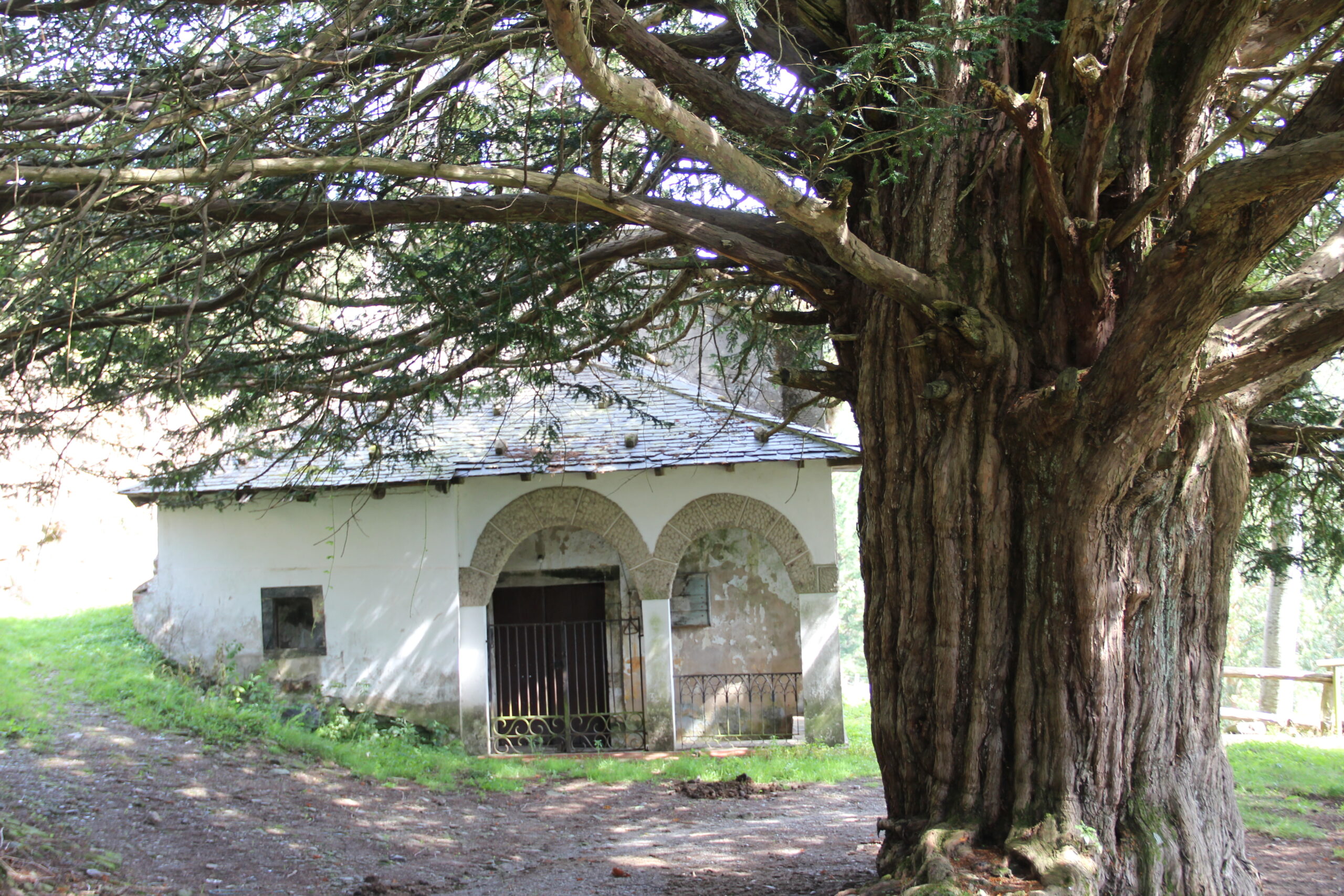
In dozens of Asturian villages the scene repeats itself: a rural church or hermitage and, right beside it, a huge, dark yew tree that looks as if it had been there forever. Often it is the other way round from what it seems: the tree came first. The yew (Taxus baccata, texu in Asturian) was a sacred tree for the ancient peoples of northern Spain, and tradition says that the first Christian churches were built next to yews that were already places of gathering and worship, embracing that sacredness instead of fighting it.
A tree between life and death
Few species carry such contradictory symbolism. The yew is evergreen and extraordinarily long-lived: it grows slowly, its crown stays green all year round and it can live for many centuries, so it seemed almost immortal and became a symbol of enduring life. Yet it is also a poisonous tree: every part of it, except the red flesh around the seed, contains taxine, a toxic alkaloid. Classical authors already wrote that the Astures and Cantabri resorted to that poison rather than surrender, and that reputation tied it forever to the world of the dead.
That double nature gave rise to customs that survived into recent times: bringing a yew branch to the deceased on All Saints’ Day to guide them on their return, holding the concejo abierto — the open village assembly that settled local affairs — in the shade of the yew in the square, or young women throwing yew berries at young men as they left a pilgrimage festival, the folk origin attributed to the Spanish expression tirar los tejos (roughly, “to make a pass at someone”). Official fact sheets put it cautiously: little of that magical past is known for certain, but the church-and-yew pairing still stands all over Asturias.
Bermiego: the Teixu l’Iglesia
The most famous specimen stands in Bermiego, in the municipality of Quirós, planted on the western slope of the Sierra del Aramo, within the grounds of the church of Santa María. Villagers know it as the Teixu l’Iglesia (“the church yew”), and it is considered one of the oldest yews in Asturias and in Europe: its exact age is unknown, for lack of studies that can verify it, but it is estimated at over a thousand years.
Its dimensions are those of a monument: about 13 metres tall, a crown 15 metres across and a trunk between 6.5 and 7 metres in girth, in an almost perfect shape. It was declared a Natural Monument on 27 April 1995. Because its roots are very sensitive to soil compaction, the ground beneath its crown is protected so that visitors do not harm it: you look, you take photographs, and you do not touch. Local tradition adds an evocative detail: according to legend, the relics of the Holy Ark passed near Bermiego on their way to Oviedo Cathedral.
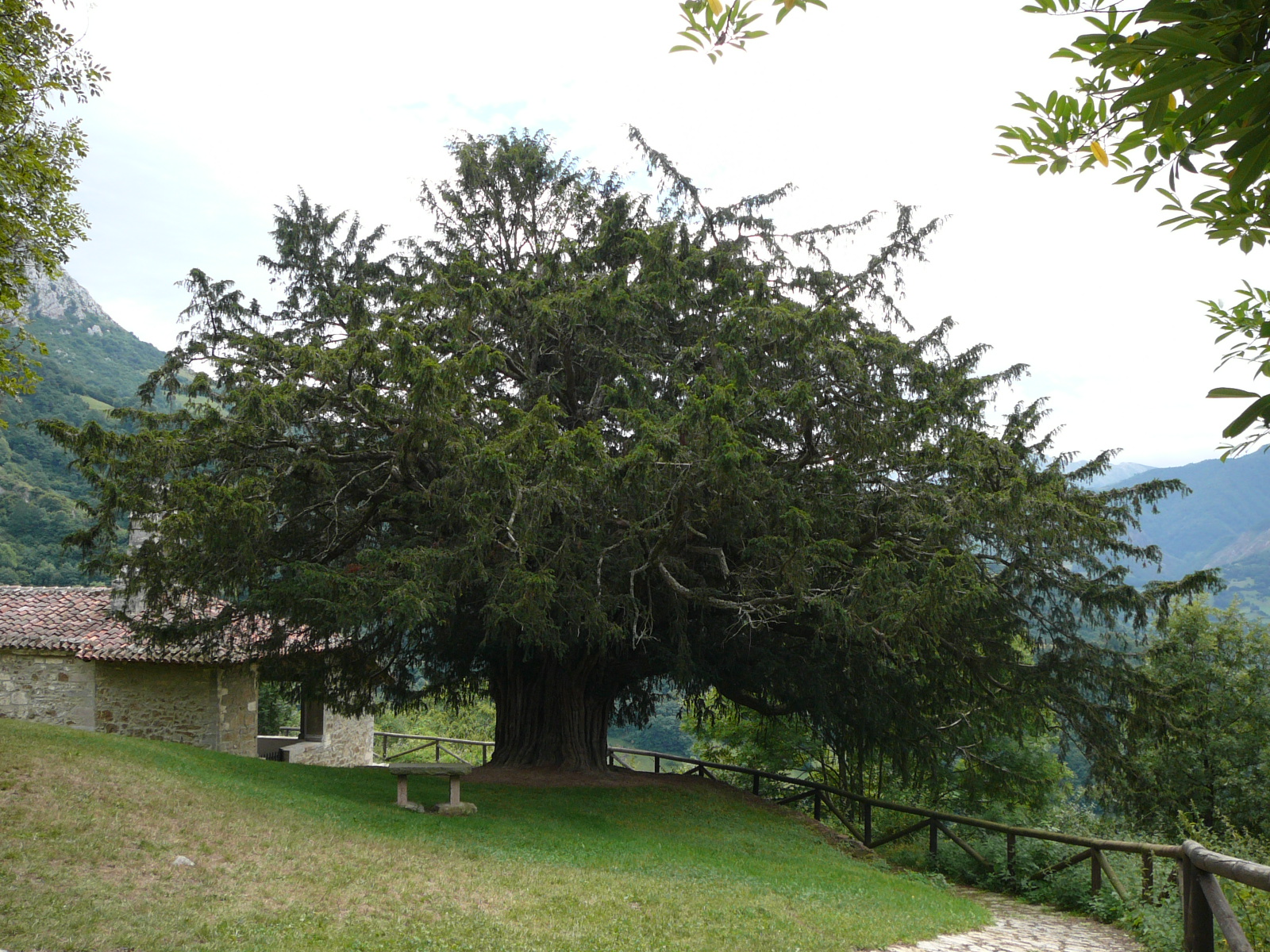
The Bermiego yew (Quirós), known as Teixu l’Iglesia, beside the grounds of the church of Santa María. Photo: Wikimedia Commons / Elfo del bosque (CC BY-SA 3.0)
Allande: the route of the yews
The municipality of Allande guards two of Asturias’ great monumental yews, linked by the so-called Ruta de los Teixos (Yew Route). The Santa Coloma yew grows beside the parish church, built in 1785 on the site of an earlier, 14th-century one. It stands 14.5 metres tall, with a spread of 12 metres and a girth of 6, and it too was declared a Natural Monument on 27 April 1995. There are actually two yews: the larger one, in front of the church, has a stone altar attached to its trunk where the Blessed Sacrament was displayed on Corpus Christi day — a sign of how deeply the tree became woven into the village’s religious life.
The Lago yew keeps company with the church of Santa María in that village, built in the 18th century over an earlier church. It is the tallest of the three: 16 metres, with a crown 9 metres across. Declared a Natural Monument by Decree 76/1995, it also lies within the Protected Landscape of the Sierras de Carondio y Valledor, a land of burial mounds, hillforts and ancient Roman gold workings.
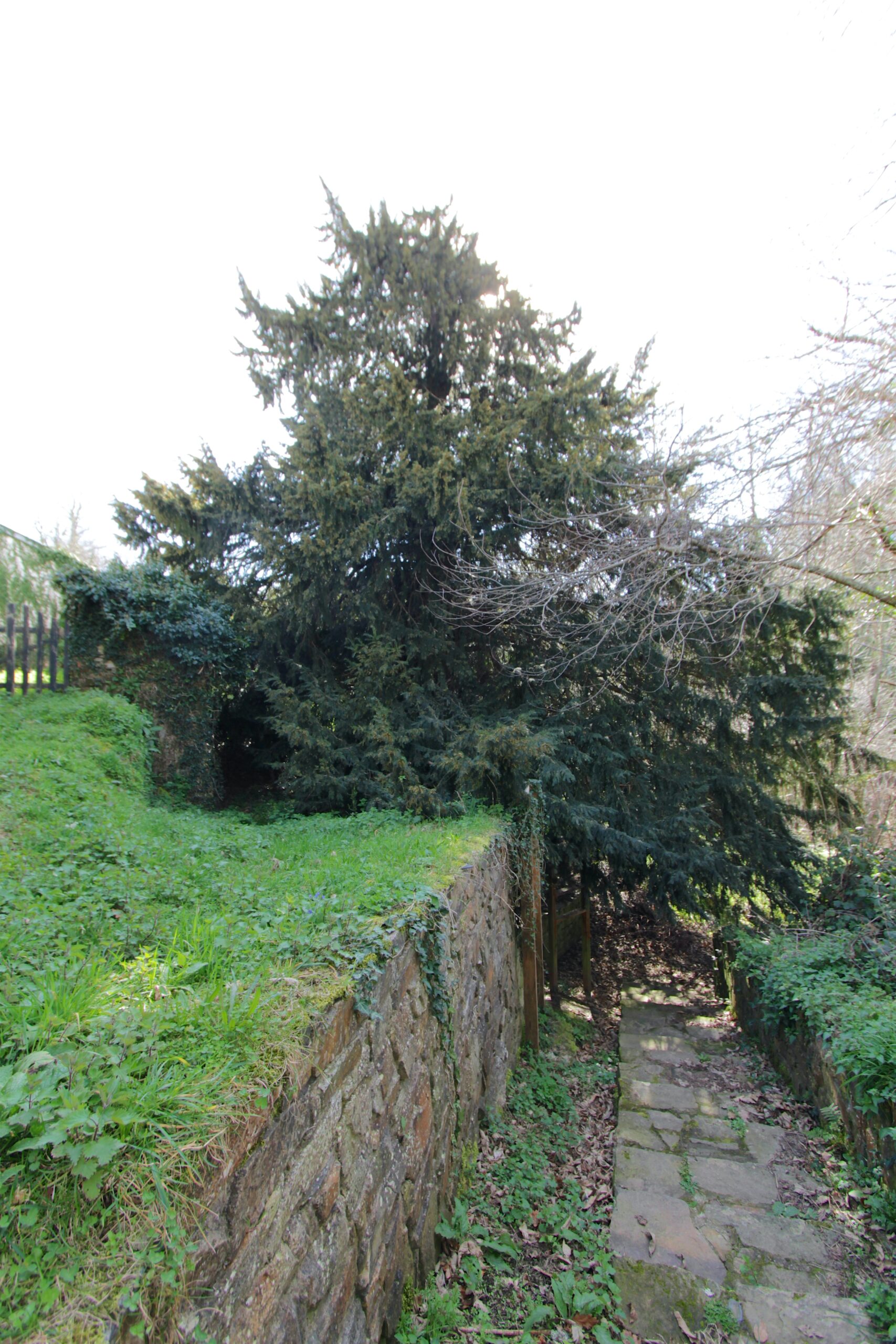
The yew of Lago (Allande), a Natural Monument beside the church of Santa María. Photo: Wikimedia Commons / SITOMON (CC BY-SA 4.0)
Pastur and the other inseparable pairs
In the west, the Pastur yew (Illano) watches over the Marian sanctuary of Nuestra Señora de Pastur. In 2008 it measured 17.5 metres in height and 20 across the crown, with a girth of just over 4 metres: estimates give it between three and four hundred years, although locally many consider it a thousand years old. It was declared a Natural Monument in 2003, and in January 2009 a storm wind split it in half, forcing specialists to treat and anchor it so it could survive. The same scene appears in other corners, such as Abamia (Cangas de Onís), where an old yew has accompanied the church of Santa Eulalia for centuries.
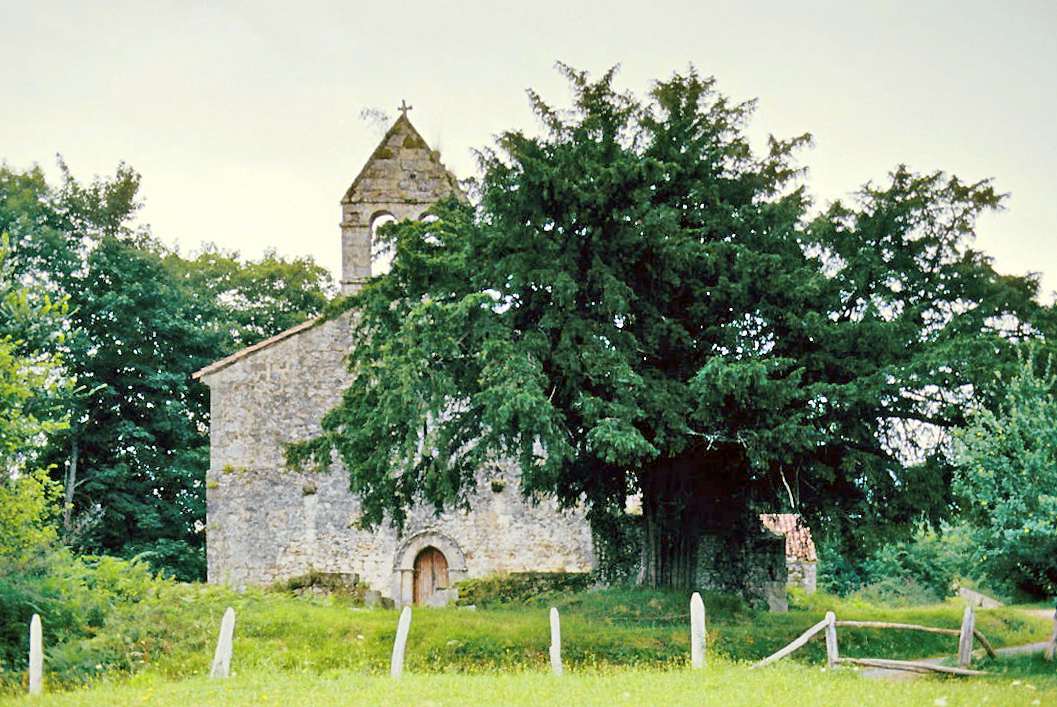
The church of Santa Eulalia de Abamia (Cangas de Onís) with its old yew, in a 1985 photograph. Photo: Wikimedia Commons / LBM1948 (CC BY-SA 4.0)
How to visit them without harming them
The monumental yews are protected by law: it is forbidden to wound their bark, carve inscriptions, drive objects into them or dig near their roots. The best visit is a quiet one: come to the village, take in the church-and-yew ensemble — the way it has always been seen — and leave no trace behind. These trees were here centuries before us; with a little care, they will still be here centuries from now.
Sources: Wikipedia (Tejo de Bermiego, Tejo de Santa Coloma, Tejo de Lago, Tejo de Pastur, Taxus), Naturaleza de Asturias and Turismo Asturias (fact sheets for the Bermiego and Lago Natural Monuments).